

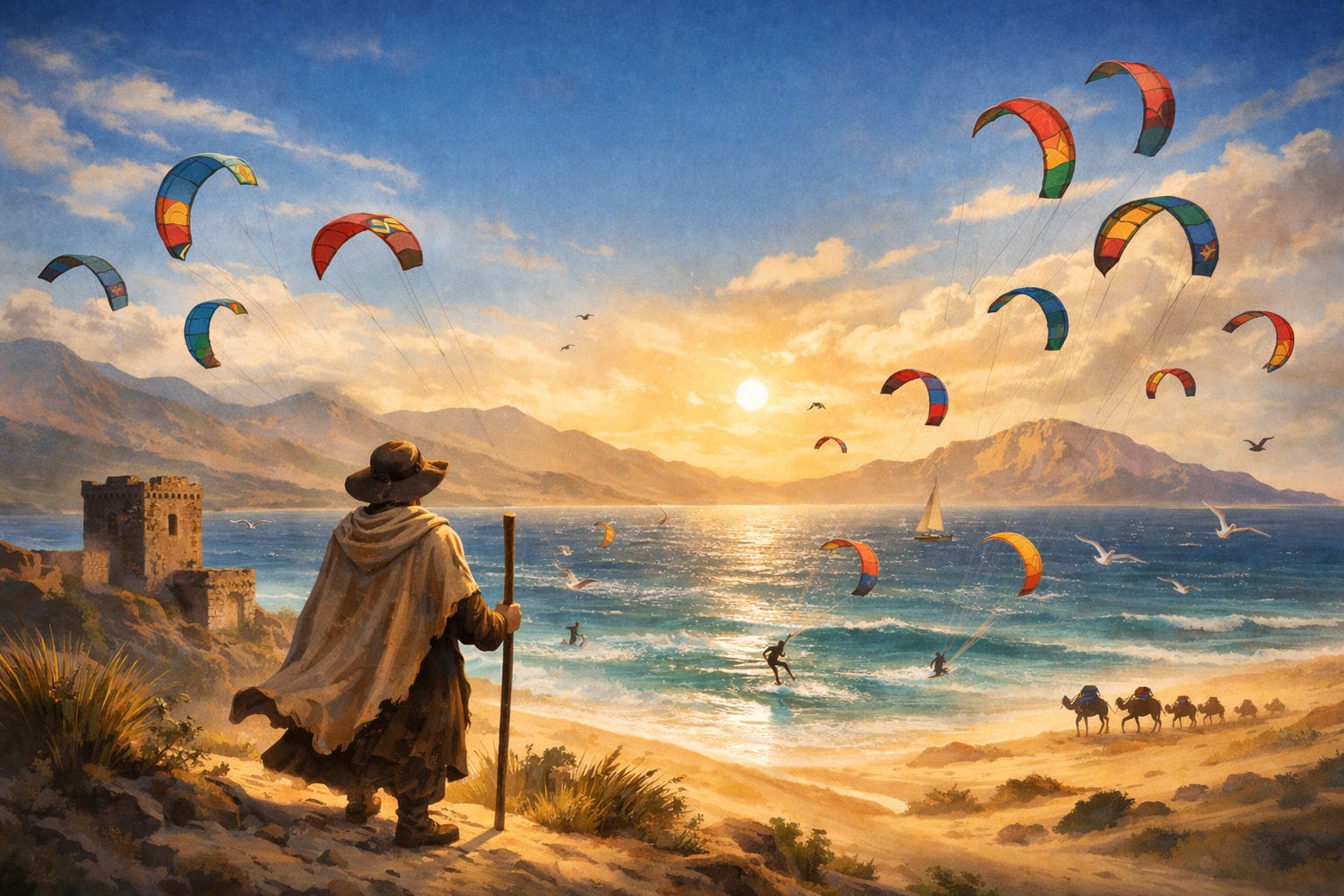
In 2003, when I started university, I did not feel fully aligned with the path I had chosen. I liked technology and the name of my degree, but each lecture hall held more theory than my brain wanted. So I retired to Tarifa for a few days to sit with whether to continue or do something else.
Tarifa sits south of Gibraltar, the southernmost town of continental Europe. A crossroads where a sea, an ocean, and two continents meet. The Atlantic to the west, Europe to the north, the Mediterranean to the east, Africa to the south. The wind is so strong that on a good summer day it can hold over five hundred kites in the air at once. It is also the town Santiago passes through in The Alchemist on his way to find his treasure in the desert.
I went to sit with a question. Not to solve it. Just to see it clearly. Would I continue my degree? The wind and I decided I’d go back.
Years passed. I finished the degree, moved to the United States for a master’s, joined an accelerator, started a company. In 2018, after a stretch of building that had taken more than it had given, I went back to Tarifa.
This time I learned to kitesurf. I biked in the hills. I worked on what I wanted to work on. Every day had the shape of an adventure, not a schedule. One afternoon I was walking back from the water and it landed clear: I am living in a playground.
Every activity there felt like an amusement park made of weather. I had grown up visiting nature, not living in it. Living inside a crossroads of that magnitude, with the wind as a cheerleader, opened something. In Tarifa I could feel that something in me pulls energy out of wind and rock and salt the way other people pull it out of coffee. I had never let myself arrange a life around that fact. I had never felt so much gratitude for where I was.
I might not have gone back to university in 2003. I might not have traveled. I might not have started the company. I might not have learned to kitesurf. Some of those decisions were conscious. Some were not.
That was the easy part to see.
Looking back, I can see that the playground was not something I found in Tarifa. Tarifa made it visible.
The harder part was realizing I could lose the playground while standing inside it. I can live somewhere with wind, sea, hills, and time, and still turn it into a waiting room if I treat my life as something happening to me.
The place helps. It does not do the work.
Ownership is the work. It does not mean I chose everything. I did not. No one does. It means the response belongs to me, and so does the next small condition I create. I can choose how I meet the day. I can choose whether I notice what feeds me. I can choose whether I wait for gratitude or practice seeing what is already here.
Viktor Frankl carries the sharpest version of that distinction. He wrote Man’s Search for Meaning from inside a Nazi concentration camp, after losing nearly everything a person can lose. He did not choose the camp. He chose how he met it. I need that distinction because without it, ownership can become cruel. We are not responsible for every condition. Even when choice narrows to almost nothing, the response still belongs to us.
Paul Conti, a psychiatrist, did not have to live through a concentration camp. He spent decades sitting with people who could have, whose lives were coming apart, watching what returns when a person comes back. What returns, he says, is agency and gratitude. He calls them verbs, not feelings. That line stayed with me because it is practical. When agency goes quiet, I stop shaping the conditions of my life. When gratitude goes quiet, I stop seeing the conditions already here. Either way, the playground shrinks.
Choosing to live in a playground does not mean I always get Tarifa. Some days there is no wind. Some days there is wind and I cannot go out. Some days the conditions are not favorable and the only agency available is the way I meet that fact. Still, the practice is the same: notice what is here, choose what can be chosen, and create one better condition for myself or someone else.
Beneath that is the part I cannot always see. I have followed currents I did not name until years later: desire, fear, pride, avoidance, longing. They were not separate from me just because I had not made them conscious.
Some of those currents are personal. Some are older than personal. They come through family, culture, language, history, biology, the human animal. Jung called that shared layer the collective unconscious: the patterns we inherit before any one person sits down to choose.
To own that layer is not to say I caused it. It is to stop pretending I stand outside it. If an old fear, image, story, or impulse moves through me, it is mine to meet because I am part of the world that produced it.
This is why Jung’s line matters to me:
We do not become enlightened by imagining figures of light, but by making the darkness conscious.
That sentence used to sound grand to me. Dreams made it practical. Every night my mind shows me material I did not consciously choose. Some of it feels personal. Some of it feels older than me. In the morning I can be tempted to dismiss it as random, but if it came through me, it is still mine to meet.
To take ownership of a dream is not to blame myself for every image. It is to stop treating the unconscious as a stranger with my face. What moved through the dream moved through me. What scared me, chased me, wanted me, or hid from me was not outside the field of my life.
Some nights I have a lucid dream and wake up inside the dream. The room is still made of mind, but now I know where I am. That is the playground getting bigger. The same darkness that looked like something to survive becomes something I can meet, ask, touch, or play with. Awareness does not erase the dream. It changes my relationship to it.
Agency and awareness pull each other up, in my days and in my dreams. The more I take ownership, the more I wake up. The more I wake up, the more I can take ownership. For a while I can run on autopilot. Life lets me. But the moment I decide to own my life, awareness stops being optional.
For me, as the loop between awareness and ownership grows, the edge between myself and the days, between myself and the dreams, and between myself and other people keeps thinning. Nothing dissolves. There is just less of me standing apart, less narrating the day, less steering the dream, less pretending the world is only happening over there.
The playground was never a place. It is the relationship that appears when I stop outsourcing my life to circumstance, mood, history, or dream. Today, I do not live in Tarifa anymore, but I do my best to keep living on the playground each day by realizing I am the playground. I am always choosing what to play with, who to play with, and how awake I am willing to be while I play.
Most mornings I go out for a walking meditation. As part of the ritual I remind myself that every decision today is mine to meet, and whatever arrives is mine to appreciate. Waking life is the same dream with more rigid physics, harder to wake up inside because it looks more real. The more I notice, the less separate I feel from what I am walking through. Before sleep, I set the same intention. The night is not elsewhere.
If almost none of this was chosen, and the response still belongs to you, what would make today more playable? What would help you wake up inside it?
What a wonderful way to share the teachings that your own life practice and deep inner work have given you. In every word, you can feel that you are not speaking from theory, but from lived experience, and that allows the person reading you to understand, in a simple and approachable way, something as profound as the awakening of consciousness.
As we grow, our purest essence gradually becomes covered by multiple layers. From the moment we are born, we constantly receive messages through family, society, education, experiences, friendships, wounds, fears, and expectations. All of this shapes our personality and builds that material mind through which we learn to live and relate to the world. Little by little, those layers end up distancing us from the most authentic connection with the being we truly are.
And what is so beautiful about your writing is that you manage to show, with clarity and sensitivity, how true inner work consists precisely in becoming aware of all those layers so that we can slowly let them go and allow the being within us to express itself freely once again.
Reading you, that profound path no longer feels distant or complicated, but instead becomes something human, possible, and close. The way you transmit it invites us to look inward without fear, with presence, responsibility, and gratitude.
And above all, thank you for the immense generosity with which you share your own inner journey and offer the wisdom you have been discovering through your experience. There is something deeply valuable in someone who shows themselves honestly in order to illuminate the path for others as well, and that is exactly what your words convey: a living wisdom, close, and profoundly human.
WOW Maveric, I love everything about this post!! Beautiful written, thank you for the reminder❣️
Life is a playground!🌹
Life by the water is best🌊 at least for me😺
And this following sentences from your post gave me full body goosebumps:
“Viktor Frankl carries the sharpest version of that distinction. He wrote Man’s Search for Meaning from inside a Nazi concentration camp, after losing nearly everything a person can lose. He did not choose the camp. He chose how he met it.”
Maybe I felt that so deeply, because I am from Germany, I went into what felt like ancestral/collective memories of a concentration camp once during a breathwork and I felt the absolute horrors of human existence while also feeling incredible deep compassion knowing even inside these horrible conditions people were supporting each other, even risking their lives to save others!